Biosphere Archive

Flora & Fauna

Known lifeforms across the Settlement. An evolving record of the organisms that inhabit its worlds, and the biology that allows them to endure.

Species records

Fauna

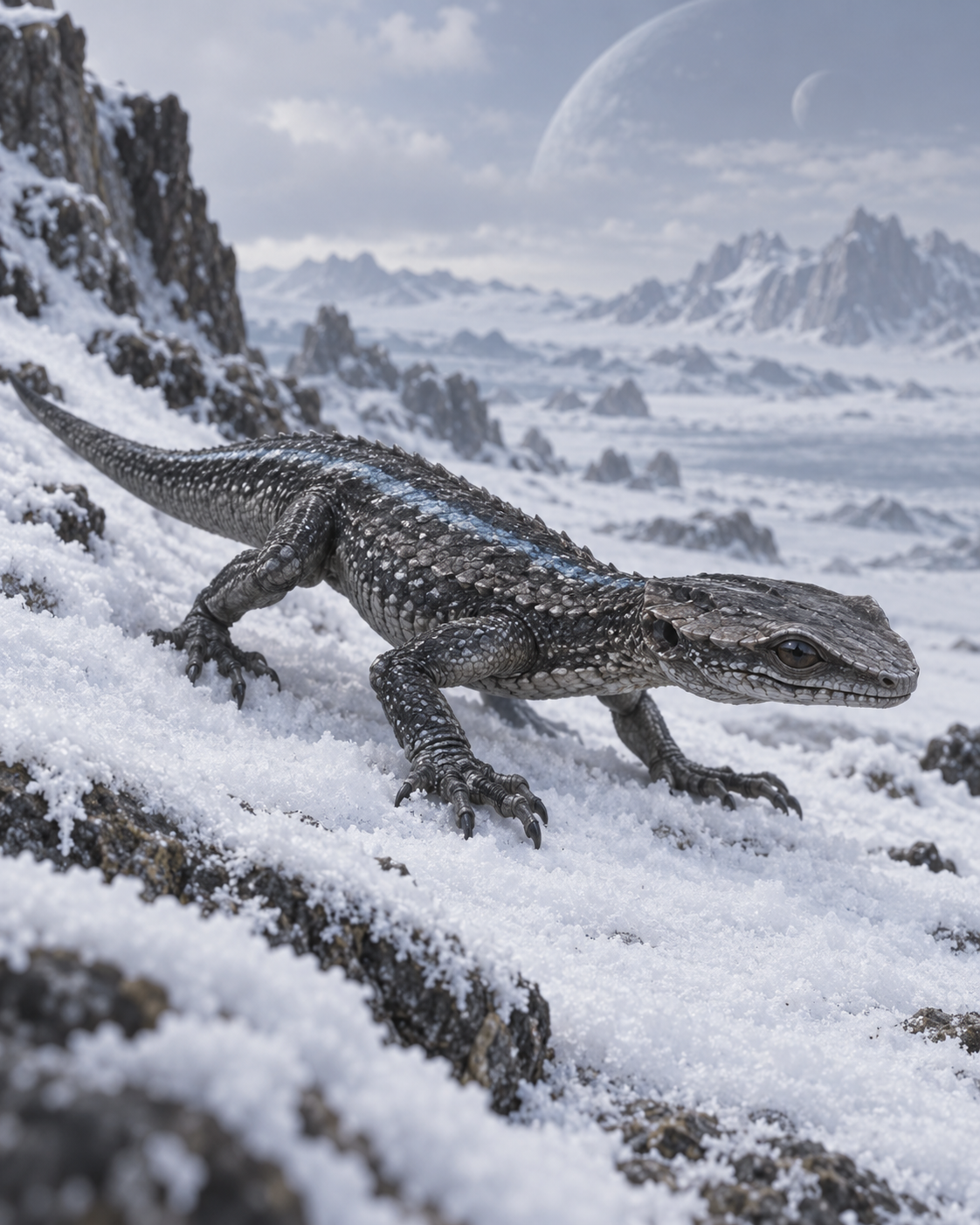
Small dark-grey Frostläufer with a flattened head and narrow blue dorsal stripe, standing in snow
01 // Frostläufer — Cyndralis III

Fauna // Entry 01

Frostläufer

Kryodromos kyanogrammos SCIENTIFIC / CLASSIFIER NAME

Known planet
Cyndralis III
Lifeform / Origin
Small terrestrial reptiloid / Native
Approximate length
20 cm
Human risk
None — harmless to humans
Signature trait
Active in snow and sub-zero weather.

A compact, low-bodied reptiloid with dark-grey scales, a flattened head and a narrow blue stripe along its back. It resembles an Earth lizard at first glance, but can remain active in snow and sub-zero weather.

Frostläufer // Archive notes

Brief warmth. Sheltered recovery.

The Frostläufer is not a conventional ectotherm: it temporarily generates internal heat through its metabolism. Controlled blood flow, heat exchange in its limbs and tail, and insulating layers beneath the skin help conserve that warmth.

This activity is costly. Short excursions alternate with recovery in shelter before the animal becomes active again; its adaptations do not make it immune to cold.

The blue stripe reflects light through microscopic structures in its scales rather than glowing and is used for recognition and social signalling. Frostläufer tolerate human-modified surroundings without being domesticated.

Diet

A small opportunistic predator, feeding mainly on small invertebrate-like organisms, larvae and other small soft-bodied fauna, with occasional carrion.

Reproduction

Live-bearing. Females produce a small number of comparatively well-developed young rather than externally incubated eggs.

Ecological role

A small predator and scavenger that helps regulate small-fauna and larval populations. Occasional carrion feeding contributes to nutrient recycling.

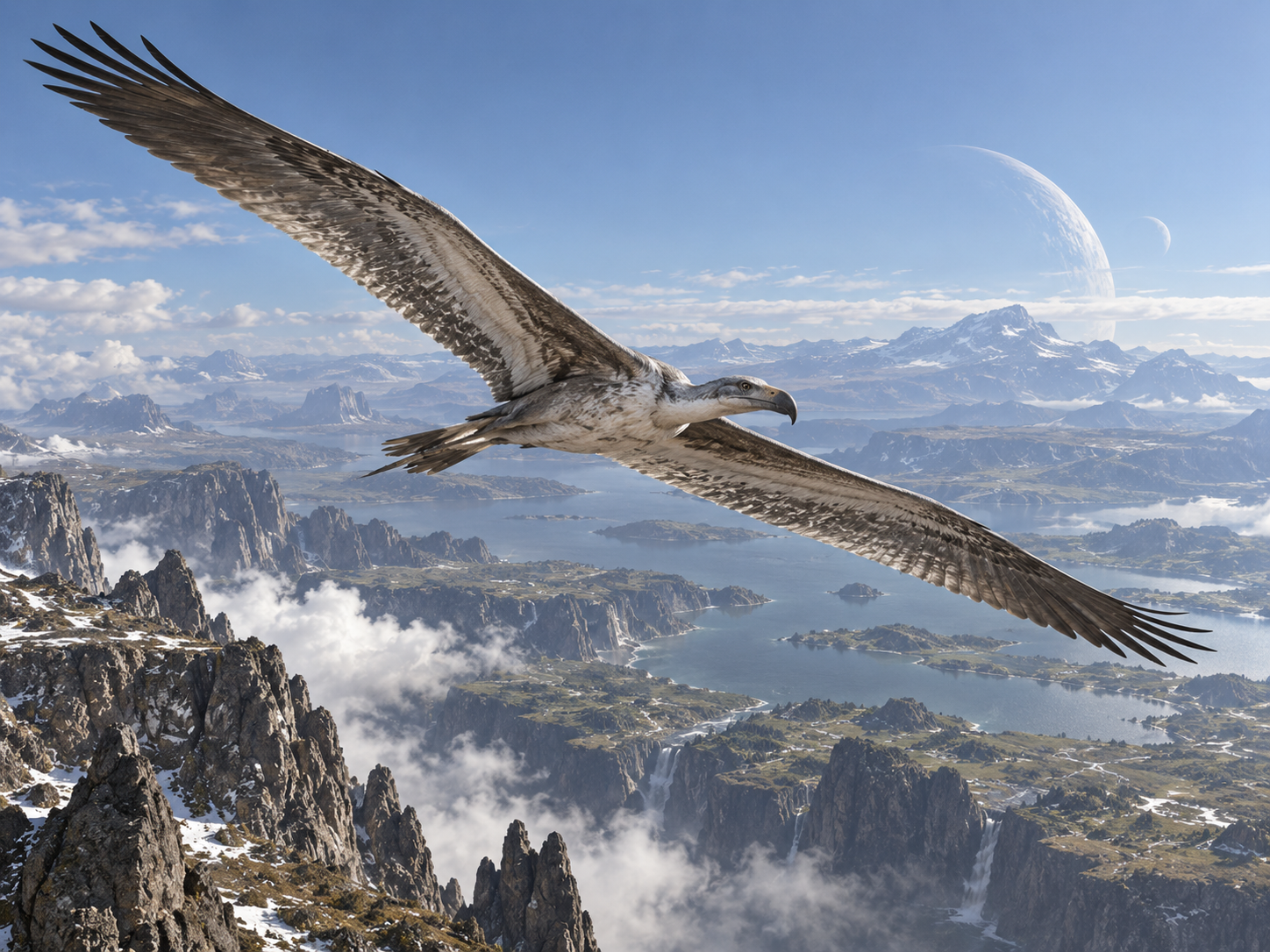
Greifensegler soaring on long outstretched wings above an alien landscape
02 // Greifensegler — Cyndralis III

Fauna // Entry 02

Greifensegler

Grypaetos makropteros SCIENTIFIC / CLASSIFIER NAME

Known planet
Cyndralis III
Lifeform / Origin
Giant volant vertebrate / Native
Approximate wingspan
11–14 m
Approximate body length
4–5 m
Approximate mass
140–220 kg
Human risk
Low under normal conditions
Signature trait
Large enough to register temporarily as an unresolved aerial contact.

One of the largest known flying animals of Cyndralis III, the Greifensegler has the span of a small aircraft. It is primarily a soaring predator and scavenger, built to travel with the air rather than fight it.

Greifensegler // Archive notes

Built for lift.

Lightweight, air-filled skeletal structures and a large respiratory air-sac system support long, narrow wings. Thermal lift, rising air and atmospheric currents carry it through extended glides. Strong wingbeats serve take-off and manoeuvring; continuous powered flapping is uncommon.

An unresolved aerial contact.

Its size, body heat and wing movement can register on military surveillance systems before there is enough data to identify an animal. A Greifensegler may briefly appear as a potential threat contact until further sensor data resolves its biological flight pattern.

It normally avoids machines and dense human activity. Close encounters can still be dangerous because of its size, especially if it is injured, cornered or defending offspring.

Diet

An opportunistic predator and scavenger, feeding on smaller aerial fauna, terrestrial animals it can safely seize, and carrion. It does not normally regard humans as prey.

Reproduction

Egg-laying, with one or two large eggs in a normal clutch. Young develop slowly and require extended parental protection before becoming fully independent flyers.

Ecological role

An upper-level predator and scavenger that helps regulate populations of smaller fauna and removes exposed carrion.
Botanical records

Flora

No flora entries currently archived.