Kinetic
Chemically propelled projectiles. Proven, maintainable and supplied through standardized ammunition.
Constraint // Heavy armorTechnical Archive // Reconstructed Infantry Armament
Recovered principles. Standardized service.
HDF infantry weapons did not appear as a clean technological break. They emerged through post-Apoklysmus recovery: chemistry, metallurgy and power systems reconstructed from damaged knowledge, then refined into interoperable military standards.
Fielded Technology // ~128 AO
Chemically propelled projectiles. Proven, maintainable and supplied through standardized ammunition.
Constraint // Heavy armorSplitcore-powered focused energy with high precision and no recoil.
Constraint // Heat and atmospheric interferenceElectromagnetic acceleration for extreme range and penetration in specialist weapons.
Constraint // Mass, energy and maintenanceHDF Standardization
HDF procurement standardizes one caliber per weapon class and normalizes Splitcore Type-1, Type-2 and Type-3 cells. Certified manufacturers work within framework contracts, while reserve stockpiles are planned for two years of combat operations.
03 // Standard Sidearm
Kinetic Service Pistol

The KSP-12 is conservative in function and advanced in construction: a rugged, field-serviceable sidearm whose electronic status layer never replaces its mechanical controls.
Its enclosed action and ceramic-metal shell are engineered for dust, rain, cold and general Cyndralis field conditions.
Ammunition Architecture
The conventional cased architecture uses a lightweight polymer-metal hybrid case. HDF caliber standards preserve ammunition compatibility across approved manufacturers.
The KSP-12 does not require WSI, Smart-Link, implants or network access to fire.
04 // Restricted Precision System
Heavy Semi-Portable Anti-Materiel Precision Rail Rifle
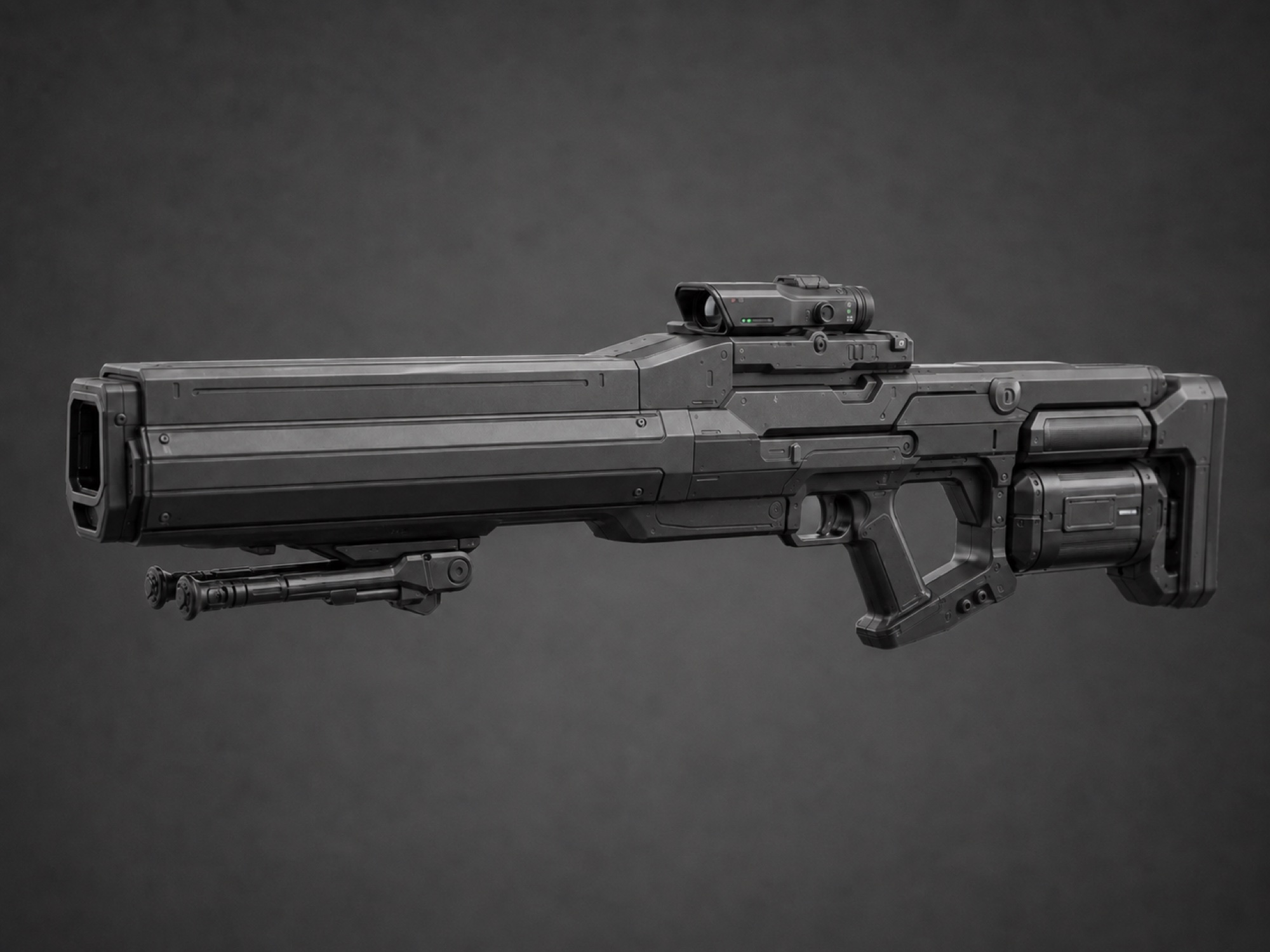
The Mk.I is not a normal infantry rifle. It is a heavy specialist instrument approaching the upper practical limit of individual carriage, built to defeat light vehicle armor and hardened field cover at extended range.
Projectile feed and electrical power remain separate: a five-round penetrator cassette is paired with a replaceable Splitcore Type-3 cell.
Full-Power Recycle
The interval covers capacitor recovery, thermal stabilization, magnetic field re-synchronization and practical reacquisition of a precision firing solution. The five-round cassette remains a separate feed operation.
Construction Logic
A long ceramic-metal body encloses the electromagnetic accelerator without decorative coils. The compact rear power and shoulder section creates an approximately bullpup-like balance, while the structural recoil path, sensor spine and folding bipod make its heavy specialist role visible.
Current HDF Arsenal // Reference Only
Development // Restricted
Needle weapons, plasma infantry weapons, programmable modular ammunition, miniaturized infantry rail systems and FerroCyte-integrated infantry weapons are not fielded technology around 128 AO.