Worlds & Orbital Nodes
Established routes connect inhabited planets, major moons, stations and transfer infrastructure where demand justifies a permanent link.
Settlement Infrastructure // Intra-System Network
Corridor Field Transit
Fixed infrastructure for travel between worlds, moons and orbital nodes inside one star system.
Principle of Operation
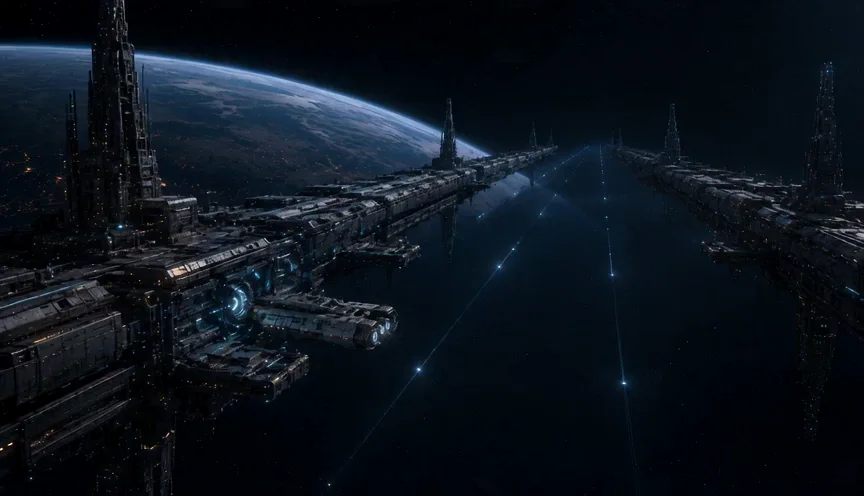
Two synchronized Gates establish a directional inertia-reduction corridor along a calibrated route. A Rising-Ship enters at the origin and flies the entire physical distance in normal space under its own propulsion and full pilot control.
The field reduces the effective inertia acting on the ship, allowing sustained acceleration that would otherwise be lethal. It does not teleport the vessel, open a wormhole or shorten the distance.
A valid resonance transponder confirms vessel and route access.
Origin and destination Gates establish the fixed directional corridor.
The crew maintains course through the open corridor.
Speed is reduced gradually before arrival at the destination Gate.
Network & Infrastructure
Established routes connect inhabited planets, major moons, stations and transfer infrastructure where demand justifies a permanent link.
The Ascension network continues to outer-system nodes while conventional shuttles retain the surface-to-orbit role.
Interstellar travel begins only after transfer to the separate Deep Relay network. Ascension itself never crosses between stars.
Every route is infrastructure rather than an arbitrary destination: two known endpoints, continuously tracked and synchronized for one directional corridor.
Transit
Passenger operations follow a controlled sequence of acceleration, high-speed cruise and deceleration. Surface-to-orbit travel remains the work of conventional shuttles.
Within Cyndralis, published journey times stay fixed even as orbital distances change. The network absorbs the resulting variation in field and engine demand.
Strategic Importance
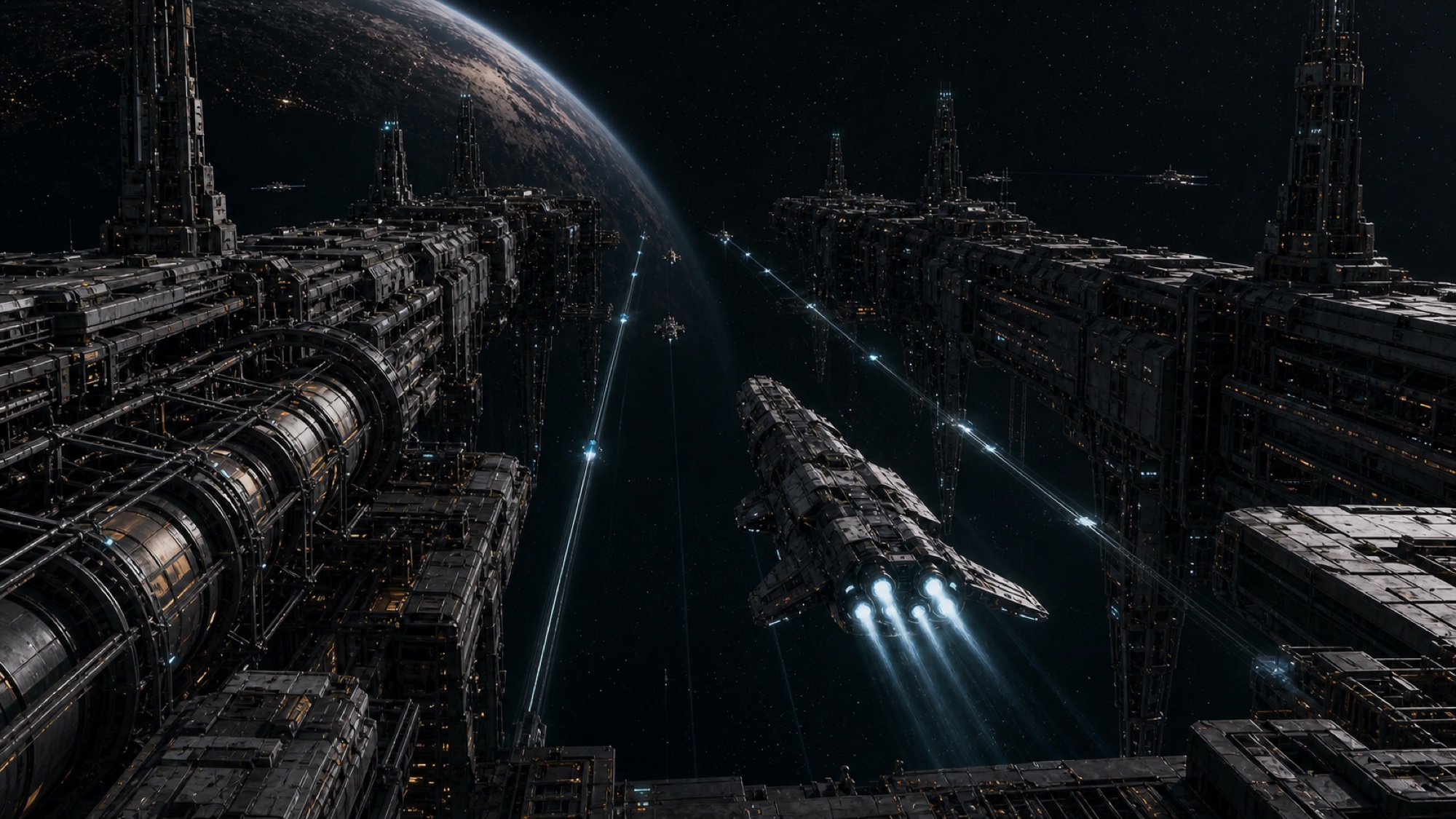
Passenger movement, freight and military deployment within a system depend on the same physical network. Cargo uses standard Gate infrastructure while operating under a different acceleration profile.
Access is enforceable. Without a valid resonance transponder, a vessel cannot enter a corridor; control of an endpoint can therefore delay movement or isolate a world from its established routes.
Risks & Limitations
A Gate cannot establish an arbitrary point-to-point connection. Both endpoints must be calibrated and synchronized.
A vessel that leaves the corridor loses inertia reduction. The returning acceleration load can be lethal.
Synchronization instability can disturb the corridor and threaten every ship inside it.
An Ascension corridor cannot be extended across interstellar distance. That physical problem belongs to the Deep Relay network.
System Boundary
Ascension solves planetary-scale distance inside a star system. Interstellar transfer requires an outer-system Deep Relay, typically reached after approximately two to three Ascension travel days from the primary inhabited region.
No operational pre-Apoklysmus jump-ships remain. The Deep Relay archive records the separate infrastructure that connects one star system to another.
Ascension moves through a system. Deep Relay moves between systems.