Shuttle
Conventional craft connect the surface with orbital transport infrastructure.
Settlement Infrastructure // Interstellar Network
Metric Displacement Transit
Outer-system infrastructure that makes practical travel between star systems possible.
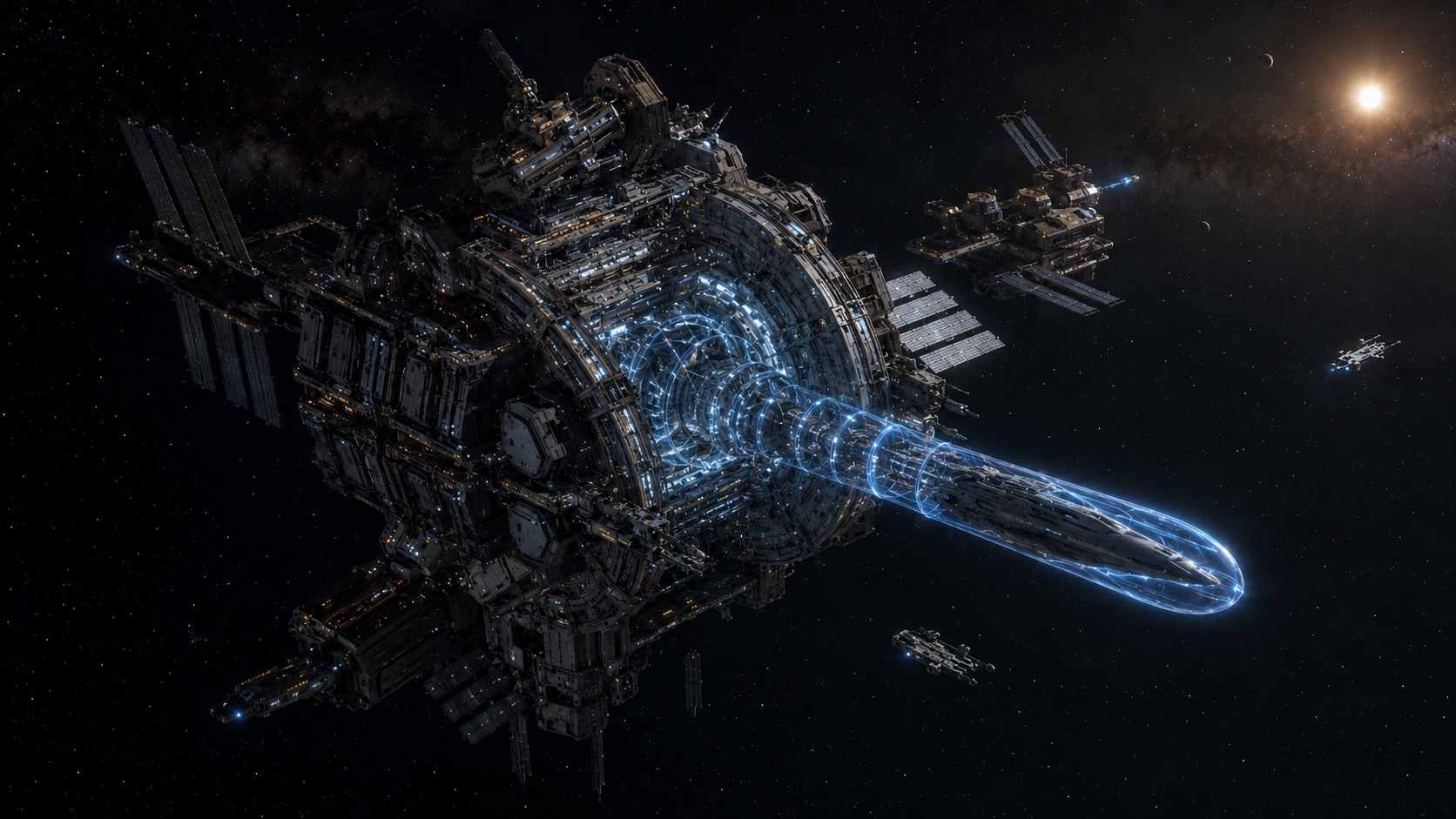
Principle of Operation
The departure Relay generates a localized Metric Displacement Field around an Aether-Ship. Space ahead contracts relative to normal space while the geometry behind the vessel relaxes.
The ship remains inside the field throughout transit and does not locally accelerate beyond light speed. This is neither teleportation nor a wormhole, tunnel, continuous beam or interstellar Ascension corridor.
The origin Relay forms the field around the accepted vessel.
The Aether-Ship maintains the established field during transit.
Local geometry carries the ship along its certified route.
The destination Relay acts as Metric Recovery Anchor and returns the vessel to normal local spacetime.

Transport Architecture
Conventional craft connect the surface with orbital transport infrastructure.
A Rising-Ship crosses the physical distance to an outer-system transfer point through a fixed inertia-reduction corridor.
An Aether-Ship travels between certified Relays inside a localized Metric Displacement Field.
The destination Ascension network and final shuttle transfer complete the journey to the planet.
Canonical route: Planet → Ascension Gate → Deep Relay → Deep Relay → Ascension Gate → Planet.
Certified Range
A Relay cannot send a vessel to any star inside its maximum range. Every connection is a Certified Relay Route built from destination geometry, stellar motion, known mass concentrations, gravitational hazards, arrival tolerances and recovery windows.
Distances classify a route; they do not define a rigid linear travel-speed formula.
Settlement Cartographic Authority
INITIALIZING SETTLEMENT CARTOGRAPHY // STANDBY
DRAG TO ROTATE // SCROLL OR PINCH TO ZOOM // SELECT A SYSTEM

Relay Exclusion Zone
Field generation requires sufficiently low and predictable gravitational gradients. Every Relay therefore operates in the outer system, beyond a locally defined exclusion zone shaped by stellar mass, planetary architecture, major moons, magnetospheres, local mass concentrations and safety margins.
There is no universal placement in astronomical units. Operationally, a Relay is typically approximately two to three Ascension travel days from the primary inhabited planetary region.
Transit Envelope
A single interstellar hop takes approximately two to ten days. Total travel also includes the Ascension transfer to the origin Relay and away from the destination Relay.
A typical neighboring-system journey takes approximately nine to thirteen days: two to three days outward, five to seven days across a typical five-light-year link, then two to three days inward.
Certified Network
Backbones, local clusters, junction systems, chokepoints and isolated branches replace universal point-to-point access.
Pre-calculated windows use precise clocks, ephemerides, stellar-motion models, arrival tolerances and recovery schedules.
Relays do not maintain realtime interstellar communication. Transit is scheduled from previously calculated route data.
No operational jump-ships remain. Conventional interstellar travel takes years or decades.
Human Control
Advanced computation models trajectories, predicts field behavior, monitors transit and calculates arrival corrections. Human operators authorize the route, launch, vessel acceptance, abort and infrastructure isolation.
The system may refuse an unsafe launch. It may not independently choose another destination.
If the Relay network fails, distance becomes real again.
Interstellar trade, civilian movement, diplomacy, military mobility, technical exchange, migration and emergency supply all depend on these fixed installations.